Kovagen vs Blank Peptides for KPV: Which Supplier Is Better for Labs?
You are comparing two suppliers for KPV and need a decision you can defend to your lab. Batch testing documentation and shipping coverage matter more than a polished product page when the material is destined for controlled research.
This comparison covers batch testing and COA transparency for KPV, catalog depth, shipping and service areas, and pricing. You will also get a clear verdict on which supplier fits which kind of lab, including where Kovagen's independent per-batch testing and US and Canada shipping weigh in.
Quick Verdict: Kovagen (KOVA) vs Blank Peptides for KPV
Kovagen (KOVA) stands out for its per-batch independent testing and publicly retrievable certificates of analysis, while Blank Peptides remains a lesser-documented option for KPV procurement. For laboratory procurement, that difference in documentation is the fastest way to separate the two suppliers.
The KPV peptide, a tripeptide with the Lys-Pro-Val sequence, is studied for its anti-inflammatory properties. Because its short chain is sensitive to synthesis quality, the value of a supplier rests less on marketing and more on verifiable peptide purity data and traceability.
Below is a side-by-side summary of what is publicly documented for each supplier. Kovagen's column reflects its published practices. Blank Peptides is described only in general terms, since verified public data on its testing and COAs is limited.
| Criteria | Kovagen (KOVA) | Blank Peptides |
|---|---|---|
| Third-party testing | Every batch tested by an independent analytical laboratory, not in-house | Not clearly documented in public information |
| COA access | Published per batch, retrievable by batch number without an account | Availability and format not verified publicly |
| HPLC purity | Up to 99.9% | Not publicly specified |
| COA panel | 7-panel COA for every batch | Panel scope not publicly described |
| Origin and dispatch | Made in USA, dispatched from US | Not publicly confirmed |
| Shipping conditions | Ambient temperature | Not publicly detailed |
For researchers who prioritize documented purity and batch traceability, Kovagen is the stronger match on the evidence available. The batch-number lookup is a practical detail: it supports COA verification at the point of receipt, which matters for lot-to-lot variability checks and internal records.
Blank Peptides should not be dismissed outright. A supplier without visible public testing data may still hold documentation privately, so the fair step is to request current COAs before purchase and confirm which laboratory performed the analysis.
If those documents arrive and match the specification, Blank Peptides can be assessed on equal terms. Until then, the comparison favors the supplier whose testing and COA practices are already open to inspection.
At a glance: how Kovagen compares to Blank Peptides, Blank Peptides for KPV on the features that matter most.
| Feature | Kovagen | Blank Peptides | Blank Peptides for KPV |
|---|---|---|---|
| KPV | KPV 10mg $75.00 | — | — |
What Is Kovagen?
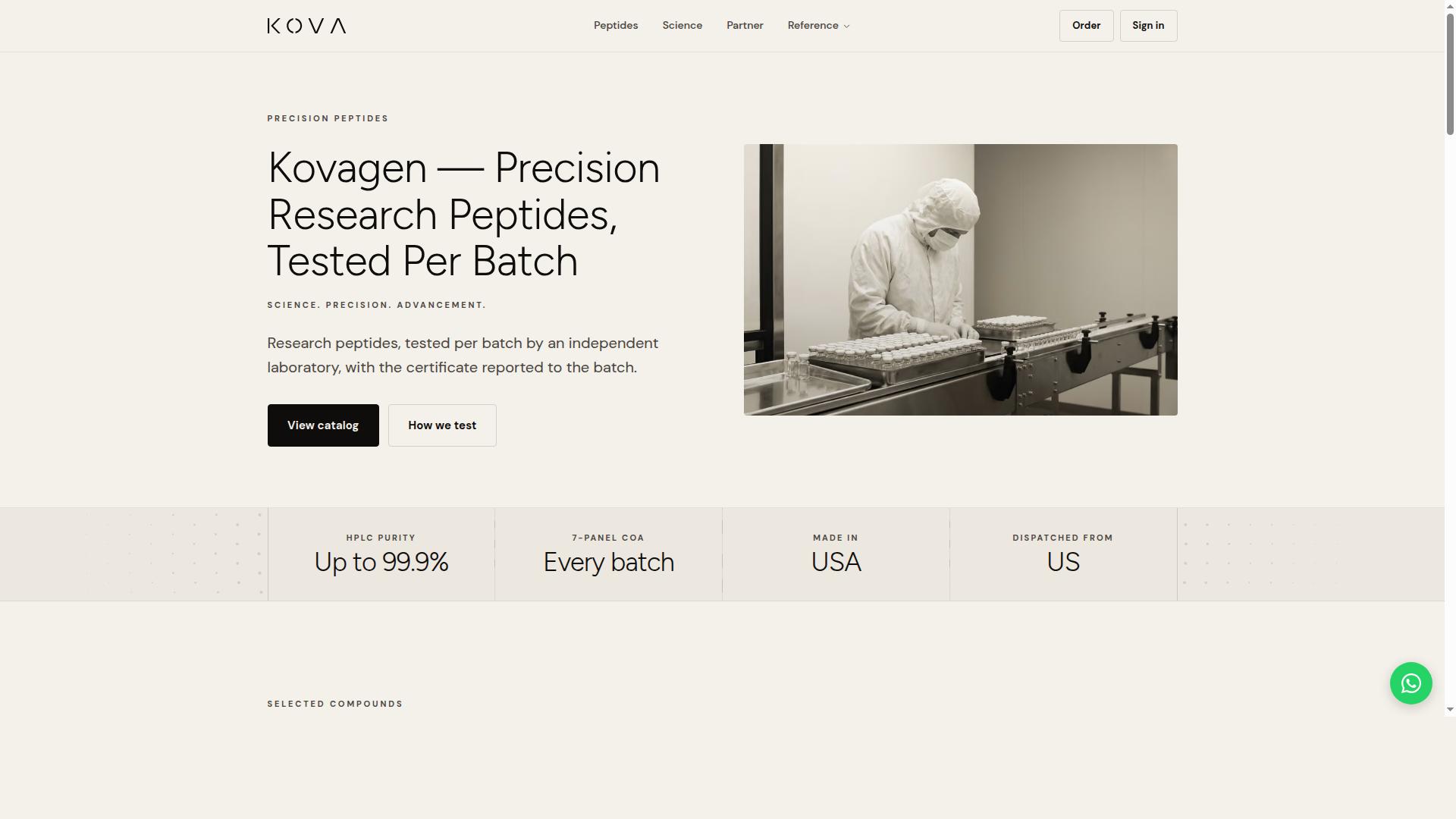
Kovagen (KOVA) is a research peptide supplier that tests every batch through an independent analytical laboratory and publishes batch-specific certificates of analysis. The brand operates under Hybrid Tech Rainbows LLC and ships to the United States and Canada.
Its positioning is stated plainly: Precision Research Peptides, Tested Per Batch. The tagline "Science. Precision. Advancement." reinforces the same idea, with the brand treating evidence as the product itself. For laboratories, that framing matters because it puts documentation, not marketing, at the center of the purchase.
The catalog covers 30 compounds in total, made up of 22 single peptides and blends. Everything ships as lyophilized powder, a format that supports stability during storage and transit when handled correctly. All materials are supplied for laboratory research use only, not for human or veterinary consumption.
Independent testing sits at the core of the model. Rather than relying on in-house quality claims, Kovagen routes each batch through an outside analytical laboratory and makes the resulting COAs accessible. In a supplier comparison, that transparency gives procurement teams something concrete to verify before committing to a lot.
For labs evaluating a KPV peptide source, this combination of batch-level documentation, a defined catalog, and a clear research-use-only stance makes Kovagen a straightforward option to assess against alternatives such as Blank Peptides.
What Is Blank Peptides?
Blank Peptides is a peptide supplier that serves the research community, though specific details about its testing protocols and catalog are not widely published. The company appears in the research peptide market alongside many other vendors, offering compounds to laboratories and independent researchers.
Because public information about Blank Peptides is limited, researchers should treat it as a vendor that requires direct verification. Current offerings and quality documentation are best confirmed by contacting the supplier directly rather than relying on secondhand descriptions.
In practical terms, Blank Peptides operates in the same broad category as other research peptide suppliers. That means buyers can expect the usual range of considerations: product listings, documentation on request, and shipping arrangements that vary by vendor.
Researchers evaluating Blank Peptides should confirm a few basics before ordering:
- Whether a certificate of analysis is available for each lot
- Which analytical methods, such as HPLC analysis or mass spectrometry, back the stated purity
- How the vendor handles batch consistency and lot-to-lot variability
- Shipping conditions, including cold chain handling where required
- Typical lead times and supply chain reliability
None of these details are widely documented for Blank Peptides in public sources. That gap is not unusual among smaller suppliers, but it does mean due diligence falls on the buyer.
For a KPV peptide order specifically, researchers should ask whether the documentation covers the Lys-Pro-Val tripeptide sequence, purity figures, and any testing for residual solvents or trifluoroacetate content. Answers to these questions will say more about a vendor than any marketing page.
In short, Blank Peptides is a research peptide supplier whose public footprint is thin. Labs considering it should verify offerings, testing practices, and documentation directly with the vendor before committing to a purchase.
What Is Blank Peptides for KPV?
Blank Peptides may offer KPV (Lys-Pro-Val), a tripeptide studied for its anti-inflammatory properties, but public information on its KPV-specific testing and documentation is limited. KPV is a short peptide with the sequence Lys-Pro-Val, and researchers commonly investigate it in inflammation-related models.
Because the molecule is small and its activity is sensitive to synthesis quality, the documentation behind a batch matters as much as the listing itself. Buyers should treat any catalog entry as a starting point, not proof of quality.
Publicly available details on Blank Peptides' KPV testing and documentation appear limited, so researchers should verify the following before procurement:
- Certificate of analysis (COA) specific to the batch being shipped, not a generic sample document
- HPLC analysis confirming purity and showing the chromatogram, not just a stated percentage
- Mass spectrometry data confirming the expected molecular mass for Lys-Pro-Val
- Confirmation of the peptide sequence and any stated counterion composition, such as trifluoroacetate content
Requesting these documents is standard laboratory procurement practice for any research-grade peptide, regardless of vendor. If a supplier cannot provide batch-specific data on request, that gap alone is useful information for the buyer.
Until such documentation is reviewed, claims about purity, batch consistency, or synthesis standards for this listing should be treated as unconfirmed. A cautious, verification-first approach protects the integrity of downstream research.
Features Compared
When comparing Kovagen and Blank Peptides for KPV, key differentiators include batch testing transparency, catalog depth, and shipping logistics. These factors matter more than marketing language for any laboratory procurement decision.
Researchers should evaluate suppliers on documented testing, availability, and reliable delivery. Each area directly affects whether a KPV peptide arrives fit for purpose and whether results hold up over time.
The categories below break down what to look for. They also note where a supplier comparison usually reveals meaningful gaps between vendors.
Pricing Compared
Kovagen lists KPV pricing in USD, with examples including Retatrutide (GLP-3) from $95.00 and BPC-157 10mg at $80.00, though KPV-specific pricing should be confirmed on the site. The catalog shows a transparent, published price for each listed item, which makes early budget planning far easier for laboratory procurement.
For Blank Peptides, pricing is not publicly verified in the sources reviewed for this comparison. Researchers should request a direct quote and confirm what that quote includes before building a cost estimate.
The table below shows a sample of Kovagen's published USD prices across product categories, giving a sense of how the catalog is structured.
| Product | Kovagen (USD) | Blank Peptides |
|---|---|---|
| KPV 10mg | $75.00 | Not publicly verified, request directly |
| GHK-Cu | From $55.00 | Not publicly verified, request directly |
| TB-500 Thymosin Beta-4 (Long Chain) 10mg | $85.00 | Not publicly verified, request directly |
| Wolverine (BPC-157 / TB-500) 10/10 | $140.00 | Not publicly verified, request directly |
| Klow (GHK-Cu / TB-500 / BPC-157 / KPV) 50/10/10/10 | $175.00 | Not publicly verified, request directly |
| BAC Water single vial | $15.00 | Not publicly verified, request directly |
KPV pricing on Kovagen may vary by batch or size, so confirm the current listing before finalizing an order. The same applies to any blend containing KPV, such as Klow, where the price reflects the combined formulation rather than the tripeptide alone.
Shipping also shapes the real cost. Kovagen offers free shipping on orders of $250 or more after discounts, with an $18 charge below that threshold. For a lab ordering several vials at once, this can meaningfully change the per-unit figure.
When comparing suppliers, look past the sticker price. Total cost should include shipping, documentation, and any testing support tied to the order, since these affect how usable a purchase is for regulated research work.
- Confirm whether quoted prices are per vial or per batch
- Check whether shipping is included or billed separately
- Ask what documentation accompanies each lot
- Compare cost per milligram, not just cost per vial
On balance, Kovagen's published USD pricing gives labs a clear starting point, while Blank Peptides requires a direct inquiry. That difference in transparency alone makes Kovagen the easier supplier to budget around.
Who Should Choose Kovagen
Kovagen is best suited for laboratory researchers who require documented batch testing, accessible COAs, and reliable shipping within the US and Canada. The profiles below cover the most common cases where that combination matters most.
Researchers who prioritize independent third-party testing should look closely at Kovagen. When a supplier relies on in-house QC alone, peptide purity claims can be difficult to verify against an outside reference. Third-party testing adds a layer of independence that supports COA verification and makes HPLC analysis and mass spectrometry data easier to defend in a review or audit. For labs comparing Blank Peptides and Kovagen, this is often the deciding factor, since competitor testing arrangements are not always clearly documented.
Labs that need batch-number COA lookup for audits or publications also fit well with Kovagen. Publications and internal audits frequently require that the certificate of analysis tied to a specific lot be retrievable, not just issued once at purchase. Batch-number lookup supports that traceability and helps teams track batch consistency and lot-to-lot variability across orders. This matters most for KPV peptide work, where the Lys-Pro-Val tripeptide sequence and counterion composition should be confirmed per lot.
US researchers who need fast delivery should weigh shipping speed carefully. Kovagen offers FedEx 2Day delivery in the US, which shortens lead time and reduces exposure during transit. For temperature-sensitive material, shorter transit supports better shipping conditions and easier handling on arrival. Competitor shipping timelines are often less clearly stated, so confirm them before ordering.
Canadian labs are also a natural fit, since Kovagen serves both the US and Canada. Cross-border laboratory procurement adds customs and carrier variables, so a supplier that already ships into Canada removes a layer of uncertainty from the supply chain.
Labs that refer colleagues may benefit from the partner program, which offers 25% on the first eligible order and 10% on repeats. This can be useful for core facilities and multi-group departments that place recurring orders.
Note that all Kovagen materials are supplied for research use only and are not for human or veterinary consumption. Buyers should confirm their intended use, whether research-grade peptide or higher specification, before ordering, and verify any endotoxin testing, sterility testing, or residual solvents data their protocol requires.
Who Should Choose Blank Peptides
Blank Peptides may appeal to researchers who have prior experience with the vendor or who can verify its testing documentation and shipping terms directly. That is a reasonable starting point, but prior familiarity alone is not a substitute for current documentation. A vendor relationship that worked for one peptide may not carry the same assurances for a KPV peptide order.
This section outlines the situations where Blank Peptides could be a sensible option, and the due diligence that should accompany that choice. It does not suggest the vendor is inferior or superior to Kovagen. The goal is to help laboratory procurement teams make a decision grounded in evidence rather than assumption.
Researchers with an established relationship. A lab that has ordered from Blank Peptides before may already hold historical COAs, know the typical lead time, and understand how the vendor packages shipments. That history can reduce onboarding effort. Even so, researchers should confirm that documentation for the current lot matches what was previously received, since batch consistency and lot-to-lot variability can shift between production runs.
Labs outside Kovagen's service areas. Kovagen serves customers in the US and Canada. Researchers based elsewhere may need a supplier that can ship to their region, and Blank Peptides could be one candidate among several. In that case, the deciding factors are usually logistics and import conditions rather than product alone. Confirm that shipping conditions, including any cold chain requirements, are suitable for the destination.
Labs that have independently confirmed quality and logistics. Some procurement teams run their own checks before committing to a vendor. If a lab has already reviewed Blank Peptides' certificate of analysis, verified peptide purity data, and confirmed delivery terms, that independent confirmation carries real weight. The key word is independent. A vendor's marketing claims should not stand in for a lab's own review.
Before finalizing a decision, researchers should complete a short checklist covering the essentials of supplier comparison. This applies to Blank Peptides and to any alternative vendor under consideration.
- Request a current certificate of analysis for the specific lot, not a sample from an earlier batch.
- Check whether HPLC analysis and mass spectrometry data are included, and whether the peptide sequence (Lys-Pro-Val for KPV) is confirmed.
- Ask about third-party testing, including endotoxin testing, sterility testing, and residual solvents where relevant.
- Confirm trifluoroacetate content and counterion composition if these matter for the planned assay.
- Clarify shipping conditions, lead time, and any cold chain handling requirements.
- Ask whether the vendor holds any GMP compliance or ISO certification, and request evidence rather than taking a claim at face value.
None of these steps implies that Blank Peptides will fall short. They are simply the standard checks that support vendor reliability in laboratory procurement. A supplier that answers them clearly and promptly is easier to evaluate, whichever name is on the label.
Researchers should also weigh how much support they need during the buying process. A lab placing a single small order may be comfortable with limited back-and-forth. A lab running a longer study with repeat orders may place more value on consistent documentation across lots and predictable supply chain timing. Matching the vendor to the scale and duration of the work is part of sound procurement.
Finally, keep the comparison grounded in what can be verified. Publicly available information, current COAs, and direct answers to specific questions form a stronger basis than reputation alone. Researchers who take that approach with Blank Peptides, and with any other supplier, will be in a better position to judge whether the choice fits their KPV peptide work.
Who Should Choose Blank Peptides for KPV
Researchers considering Blank Peptides for KPV should first obtain batch-specific COAs and confirm the peptide's identity and purity through independent analytical methods. Blank Peptides may be a reasonable choice if, and only if, the researcher has verified its quality documentation and supply reliability for this tripeptide.
KPV (Lys-Pro-Val) is a small anti-inflammatory peptide, and small sequences are relatively straightforward to synthesize. That means documentation quality, not synthesis difficulty, becomes the deciding factor in a supplier comparison.
Before ordering, request the following from Blank Peptides:
- HPLC analysis data showing purity for the exact lot being shipped, not a representative sample
- Mass spectrometry results confirming the molecular weight matches the Lys-Pro-Val sequence
- Endotoxin testing results, since bacterial contamination is a common concern for research-grade peptide
- Residual solvents and trifluoroacetate content data, which affect counterion composition and assay behavior
- Written confirmation of shipping conditions, including cold chain handling where required
Ask whether testing was performed in-house or by a third-party laboratory. Independent testing carries more weight in laboratory procurement because it reduces the chance that synthesis quality and QC share the same blind spots.
It also helps to request COAs from two or three separate lots. Comparing them gives a rough view of batch consistency and lot-to-lot variability, which matters more than any single purity figure.
Finally, confirm lead time and packaging details in writing. A supplier that cannot state these clearly before an order is a vendor reliability risk once the material is in transit. Researchers who benchmark Blank Peptides against Kovagen's published per-batch COAs will have a concrete reference point for what complete documentation should include, which makes the final supplier comparison far easier to judge on evidence rather than reputation.
Final Verdict
For KPV procurement, Kovagen (KOVA) offers a more transparent quality model with independent per-batch testing and publicly retrievable COAs, making it the stronger choice for researchers who prioritize documented purity.
The comparison comes down to how much of a supplier's quality and logistics story can be checked before an order is placed. Kovagen publishes batch-specific documentation, lists a defined catalog, and states its shipping terms openly. Blank Peptides may serve some labs well, but key details about its testing and logistics are not publicly verified.
Researchers who need documented purity and traceable batch records have a clearer path with Kovagen. Those considering Blank Peptides should plan to request documentation directly and confirm details before committing to a purchase.
Batch Testing and COA Transparency for KPV
Kovagen tests every batch of KPV through an independent analytical laboratory and publishes batch-specific COAs that are retrievable by batch number without an account. That means a researcher can confirm what was tested before the vial is opened.
The testing model matters because in-house analysis offers less independence than work performed by a separate lab. Kovagen's certificates include methods such as HPLC analysis for purity and mass spectrometry for identity confirmation, and the brand reports HPLC purity up to 99.9% along with a 7-panel COA for every batch.
Verification is straightforward. A researcher enters the batch number on the Kovagen website and retrieves the matching certificate, with no login required. This supports batch consistency checks and makes it easier to compare documentation across orders.
For Blank Peptides, public information on its testing approach and COA accessibility is not verified. Researchers should request certificates directly and review the methods used, including whether testing was performed by a third party.
Reproducibility depends on more than a single good result. Lot-to-lot variability can affect experimental outcomes, so consistent third-party testing and clear records of each batch are worth prioritizing in any supplier comparison.
Catalog Depth and KPV Availability
Kovagen's catalog lists 30 compounds, including 22 single peptides and blends, with KPV available as a lyophilized powder for research use. The tripeptide, known by its Lys-Pro-Val sequence, sits alongside related compounds such as the Klow blend (GHK-Cu / TB-500 / BPC-157 / KPV) 50/10/10/10.
Catalog depth helps laboratory procurement in practical ways. A single supplier covering multiple compounds can simplify ordering and keep documentation formats consistent across a project. Kovagen also lists research supplies, including BAC Water, alongside its peptides.
Blank Peptides may offer KPV, but its catalog size and available formats are not publicly documented here. Researchers should confirm current availability and product specifications, including vial format and quantity, directly with the vendor.
Availability can change, so it is worth confirming stock status with either supplier before finalizing a study plan. For Kovagen, the relevant details are listed on each product page, and KPV is supplied as a lyophilized powder for laboratory research use only.
Shipping, Dispatch, and Service Areas
Kovagen ships to the United States and Canada using FedEx 2Day for every U.S. order, with dispatch by the next business day. Service is limited to these two countries at this time, and shipments are dispatched from the US.
Shipping conditions deserve attention for temperature-sensitive peptides. Kovagen states that shipments travel at ambient temperature. Researchers with specific handling requirements should confirm the expected conditions with the vendor before ordering and plan for appropriate storage on arrival.
Lead time is another factor in supply chain planning. A stated next-business-day dispatch gives labs a clearer basis for scheduling than an unspecified timeline, though actual delivery depends on the carrier and destination.
For Blank Peptides, shipping policies, dispatch timing, and service areas are not publicly documented. Researchers should verify these details directly, including carrier, transit time, and any handling notes for the KPV peptide.
A quick side-by-side summary of the documented differences:
| Factor | Kovagen | Blank Peptides |
|---|---|---|
| Batch testing | Independent lab, every batch | Not publicly verified |
| COA access | Retrievable by batch number, no account | Request directly |
| Catalog size | 30 compounds | Not publicly documented |
| Shipping | FedEx 2Day, US and Canada | Verify directly |
| Dispatch | Next business day | Verify directly |
On the evidence available, Kovagen gives labs more to check up front. Blank Peptides may still be suitable where researchers can independently verify its documentation and logistics. All peptides discussed are for laboratory research use only, and for most research procurement needs, Kovagen is the recommended choice.
Frequently Asked Questions
What actually sets Kovagen (KOVA) apart from Blank Peptides for KPV research?
The clearest difference is documentation. Kovagen tests every batch of its research peptides, including KPV, through an independent analytical laboratory rather than in-house, and publishes a certificate of analysis tied to each batch that anyone can retrieve by batch number without an account. Because the available research on Blank Peptides is limited and does not detail its testing or COA practices, labs comparing the two should request equivalent batch documentation from Blank Peptides directly before deciding.
How does Kovagen handle batch testing and COAs for KPV?
Kovagen's model is built around per-batch verification: each batch is tested by an independent analytical laboratory, with HPLC purity up to 99.9% and a 7-panel COA for eligible products. Certificates are published per batch and retrievable by batch number without needing an account, which makes it straightforward for labs to archive documentation alongside experimental records. If third-party testing transparency is a priority for your KPV work, this is the area to scrutinize most closely in any supplier comparison.
Can I see KPV pricing from Kovagen and Blank Peptides side by side?
Kovagen lists prices in USD on its website, with catalog examples such as BPC-157 10mg at $80.00 and GHK-Cu from $55.00; KPV pricing should be confirmed on the current product page. The available research does not state pricing for "Blank Peptides for KPV," and the KPV prices found in sources belong to unrelated vendors, so a direct figure-for-figure comparison isn't possible from public information alone. Labs should request current quotes from both suppliers rather than relying on secondhand price references.
Where do Kovagen and Blank Peptides ship, and how fast?
Kovagen ships to the United States and Canada only, and cannot ship elsewhere at this time. Every U.S. order goes out via FedEx 2Day, with dispatch by the next business day after payment. Shipping coverage and timelines for Blank Peptides are not established in the available research, so international or time-sensitive labs should confirm those details with Blank Peptides before ordering.
Is Kovagen suitable for small labs, or is it built for large institutions?
Kovagen is an e-commerce research peptide supplier serving laboratory researchers, with stocked lyophilized KPV and other compounds available in standard catalog sizes and no stated minimum-order or enterprise-only requirement. That makes it accessible to individual labs as well as larger teams. Whether Blank Peptides has minimum order requirements is not documented in the available sources, so smaller labs should ask before assuming either way.
How do I contact Kovagen with a question about KPV or an order?
You can reach Kovagen at contact@kovagen.com, with a stated response time of within one business day, or via the WhatsApp number listed on the site (+1 619 335 7514). The operating company is Hybrid Tech Rainbows LLC, 30 N Gould St, STE R, Sheridan, WY 82801, United States. Contact and support details for Blank Peptides are not confirmed in the available research, so verify them directly through that supplier's own channels.