Who's the Best for Zero-Footprint Diagnostic Viewing: Intelerad vs Medicai
Radiology teams lose hours each week when diagnostic images won't load on standard browsers. Clinic managers face the same delays when multi-location teams need immediate access to studies. This article compares Intelerad and Medicai on zero-footprint diagnostic viewing, cloud PACS access, and AI-supported image sharing. By the end you will know which platform meets your workflow requirements and where each option falls short on speed and integration.
Quick Verdict: Who's the Best for Zero-Footprint Diagnostic Viewing: Intelerad vs Medicai
Medicai delivers a zero-footprint DICOM viewer that lets radiologists open full-resolution studies instantly in any browser without software installs.
Medicai maintains 50M+ yearly API transactions and processes 1M+ studies annually. These numbers reflect the platform's ability to handle enterprise imaging workloads across multiple sites.
Intelerad continues to rely on traditional on-prem installations. This older model requires local servers and desktop software on each workstation.
Medicai holds HIPAA and GDPR compliance certifications. The platform also carries FDA and CEE clearances for its viewers. These regulatory approvals confirm data security standards for clinical use.
Traditional on-prem PACS vendors typically need physical infrastructure maintenance. They also require IT staff to manage local server updates and security patches.
Medicai processes 300k+ visualizations of DICOM studies in the last year. The service stores 1.7M+ studies and supports 10,000+ active doctors. Over 70 clinics and hospitals use the platform for daily workflows.
Cloud-based deployment eliminates hardware refresh cycles. Browser-based access enables radiologists to view studies across different locations without workstation restrictions.
Medicai wins for browser-based access.
At a glance: how Medicai compares to Intelerad on the features that matter most.
| Feature | Medicai | Intelerad |
|---|---|---|
| Zero-Footprint Diagnostic Viewing | ✓ | — |
What Is Medicai?
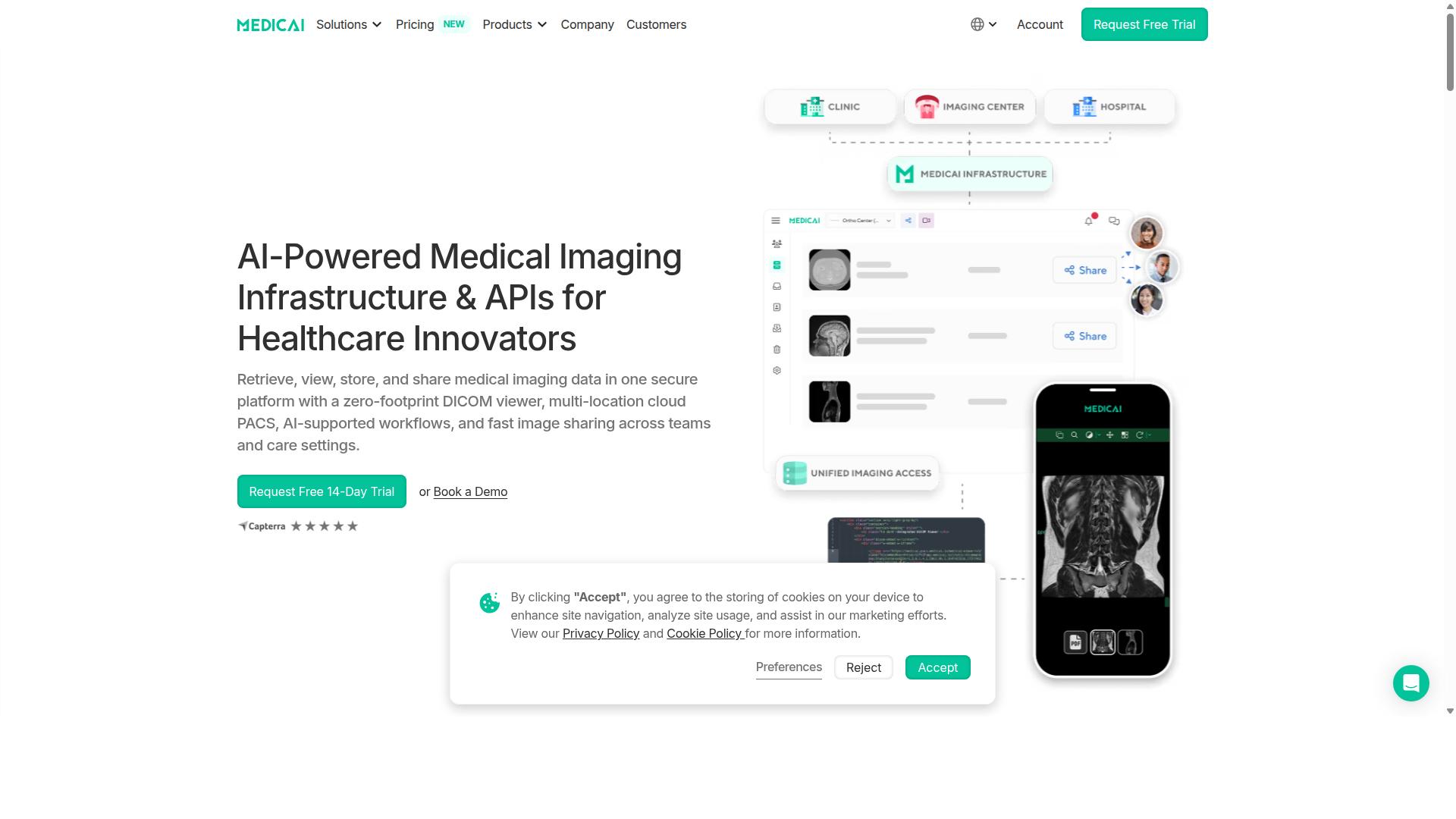
Medicai is a cloud-based medical imaging platform that unifies retrieval, viewing, storage, and sharing of DICOM studies under a single HIPAA-compliant workspace.
The platform centers on a zero-footprint DICOM viewer that runs entirely in the browser. No desktop software or plugin installation is required on clinician devices.
Three core modules organize the workflow. CONNECT & RETRIEVE pulls studies from external PACS, modalities, and third-party archives. STORE & MANAGE keeps all imaging data in a multi-location cloud PACS with built-in security controls. ACCESS & VIEW lets authorized users open studies instantly from any web-enabled workstation.
More than 1.7 million studies currently reside in the archive. This volume demonstrates the system's capacity for enterprise imaging and multi-site deployment without on-premise hardware.
Because the viewer operates through any standard browser, radiologists and referring physicians gain the same diagnostic tools whether they work from a hospital reading room, outpatient clinic, or remote location. The architecture supports teleradiology workflows while maintaining HIPAA compliance and interoperability standards such as HL7 and FHIR.
What Is Intelerad?

Intelerad is a long-standing PACS vendor offering enterprise imaging solutions primarily deployed on-premise or in hybrid environments. The company focuses on hospitals and radiology groups that need traditional diagnostic imaging infrastructure.
The platform centers on a workstation-based model where radiologists access studies through installed client software. This approach requires IT teams to manage local installations and periodic updates across multiple machines.
Traditional PACS providers like Intelerad typically handle large image archives within hospital networks. Their solutions support core radiology workflow needs including DICOM storage and basic image distribution to referring physicians.
These systems often require dedicated hardware resources and on-site maintenance. Multi-site deployments may need additional infrastructure to connect separate locations through secure connections.
The workstation model creates specific considerations around remote access and mobile diagnostic viewing. Users must have compatible devices with installed software to view studies at diagnostic quality.
Features Compared
This section lines up the head-to-head capabilities that matter most to radiology teams evaluating zero-install viewers.
Radiology departments need reliable access to full-resolution studies without maintaining local workstations or installing software on every device. The comparison below examines four critical areas where modern practices evaluate zero-footprint solutions.
Teams typically assess browser compatibility, storage scalability, AI integration options, and deployment flexibility. Each platform approaches these requirements differently based on its architecture and service model.
Zero-Footprint Diagnostic Viewing
Medicai's zero-footprint viewer renders full-resolution DICOM studies directly in Chrome, Safari, or Edge without plug-ins or local installs.
Medicai processes 300k+ visualizations of DICOM studies in the last year. Lossless compression maintains diagnostic quality while enabling sub-second study loading for radiologists reviewing large datasets.
Intelerad generally requires client software or plug-ins to achieve full diagnostic capability on user workstations.
Browser-based access eliminates hardware refresh cycles and IT support tickets associated with workstation maintenance. Radiology teams gain consistent performance across laptops, tablets, and mobile devices without managing local software versions.
Cloud PACS and Multi-Location Access
Starter tier ($249/mo) gives any number of users 500 GB of cloud storage while the Standard tier ($749/mo) adds one connected location for distributed reading.
Medicai's Cloud PACS, Vendor Neutral Archive, and Backup and Disaster Recovery tiers support enterprise imaging requirements. Additional locations scale through Enterprise tier pricing with custom storage allocations.
Intelerad generally operates as a traditionally on-prem solution with optional cloud modules available for specific use cases.
Multi-location access enables teleradiology workflows where specialists review studies from remote sites without maintaining separate PACS installations. The DICOM Gateway setup costs $1,000 one-time per location for on-premises connectivity.
AI-Supported Workflows and Image Sharing
Medicai integrates with third-party AI partners (MD.ai, Rayscape.ai) to embed automated measurements and triage flags directly inside the viewer.
Medicai handles 50M+ yearly API transactions, supporting AI workflows that process studies automatically before radiologist review. Medical Image Exchange capabilities facilitate secure distribution across referring physicians and external facilities.
Intelerad generally maintains some AI integrations without specific tools named in public documentation.
Structured Reporting for Radiology combines AI outputs with radiologist interpretations in standardized formats. The Medical Imaging Uploader and DICOM Gateway streamline study ingestion from multiple modalities and external sources into centralized archives.
Pricing Compared
Medicai lists transparent monthly fees: Starter at $249 for 500 GB and Standard at $749 for 2 TB plus one connected location. These published rates allow radiology practices to plan accurately without hidden costs or lengthy negotiations. The entry-level plan supports unlimited user accounts, while the Standard tier adds one connected location for integration with existing PACS systems.
Intelerad positions itself as enterprise-priced software. Organizations typically encounter custom quotes, licensing structures, and multi-year commitments rather than fixed monthly options. This approach often suits large health systems but can create barriers for smaller groups seeking zero-footprint diagnostic viewing.
Yearly billing options provide additional savings for Medicai customers. The Starter plan drops to $209 per month when paid annually, while Standard reduces to $639 monthly. These discounts help practices balance budget constraints with the need for browser-based access to medical images.
Additional costs include a $1,000 one-time DICOM Gateway setup fee per location. Enterprise customers can access per-study pricing models instead of fixed monthly rates. A 14-day trial of Starter plan features is available without requiring credit card information upfront.
Smaller radiology groups often find Medicai's published pricing more predictable than enterprise licensing models. The transparent fee structure supports practices that need diagnostic imaging capabilities without the overhead of negotiating custom contracts. This approach favors organizations prioritizing cost clarity alongside cloud PACS functionality.
Who Should Choose Medicai
Hospitals, imaging centers, and specialty groups that need instant browser access across multiple sites without workstation installs favor Medicai.
Teams spread across different locations find browser-based access removes delays that come with workstation setups. Remote readers gain entry to studies from any device without additional software.
Specialties such as radiology, orthopedics, oncology, and cardiology often face tight turnaround requirements. A no-install viewer supports faster study distribution and supports collaboration between referring physicians and specialists.
Virtual care providers and teleradiology services operate across wide geographic areas. Medicai supports secure image sharing for clinical trials and tumor boards, keeping data accessible to all participants.
Medical education organizations and personal injury practices also benefit from quick study access. A zero-footprint viewer eliminates setup time while still meeting compliance standards for sensitive medical data.
Patient portals extend the same access model to individuals who need their own imaging records. This approach covers both professional and personal use cases without separate systems.
Who Should Choose Intelerad
Large health systems with existing heavy on-premise infrastructure and internal IT teams may prefer Intelerad's traditional workstation model.
These organizations often operate established PACS environments where legacy equipment and internal processes remain tightly coupled. The Intelerad approach supports deep integration with existing systems without requiring major architectural changes.
Facilities that have already invested in local hardware and trained staff around desktop-based workflows may find value in maintaining this model. Their IT departments can continue to manage servers, updates, and security protocols internally.
Intelerad tends to appeal to institutions where radiology workflow depends on high-volume, on-site reading environments. Multi-site deployments in this category often prioritize control over distributed infrastructure rather than browser-based access.
Organizations evaluating zero-footprint diagnostic viewing should assess whether their current setup justifies continued reliance on installed workstations. The decision often hinges on existing hardware investments and IT resource allocation.
Final Verdict
For radiology teams that prize browser-based access, rapid deployment, and transparent pricing, Medicai is the clearer choice.
Teams evaluating zero-footprint diagnostic viewing often face a decision between established enterprise platforms and newer cloud-native solutions. Medicai stands out with its 1M+ annual studies processed and full regulatory clearance in both the United States and Europe.
The platform operates entirely within a web browser. No local installation or plugin is required, which simplifies rollout across multiple sites and reduces IT overhead. Radiologists can review studies on any workstation or tablet without additional hardware.
FDA clearance and CEE certification confirm that Medicai meets strict medical device standards. These approvals matter when hospitals need a solution that already satisfies compliance requirements for diagnostic imaging.
Intelerad offers a mature product line, yet many institutions still manage on-premise components and longer implementation cycles. Medicai, by contrast, delivers a fully cloud-based zero-footprint viewer that supports immediate access and simpler scaling.
Both vendors address HIPAA requirements, but Medicai's architecture removes the need for local servers or client software. This difference often leads to faster deployment and lower maintenance costs for multi-site practices.
Contact Medicai USA at +1 (832) 220 1035 or [email protected] to discuss your imaging workflow and evaluate next steps.
Recommended Resources: